
Strategic Planning Offsites: Why the Design Matters as Much as the Agenda
Every year, leadership teams spend significant time and money on offsites.
They’re usually well-intentioned. The organisation faces important questions — a strategic shift to explore; tensions between functions that are slowing progress; a need to step back and think. So the team gathers for a day or two away from the office. Slides are prepared. Frameworks are introduced. Priorities are discussed.
For a while, it feels productive. . .
Then the team returns to the business — and something familiar happens. The same tensions reappear. Decisions that felt made begin to unravel. Conversations that seemed resolved resume exactly where they left off. The offsite produced activity. Not transformation. And yet the appetite for organisational change was real
The problem wasn’t the intention — it was the design.
The problem isn’t the people
Most leadership teams are composed of capable, thoughtful individuals. They understand their business, their markets, the strategic challenges they face.
The problem isn’t intelligence. It isn’t commitment. It isn’t even the quality of the strategic thinking. The problem is how almost every offsite is designed.
Most offsites focus almost entirely on content.
What strategy should we pursue? Which priorities matter most? How should resources be allocated?
These are important questions. But they overlook something equally critical: how the leadership team is actually working together while trying to answer them.
This means working across three domains simultaneously: the business strategy itself, the group dynamics shaping how the team operates under pressure, and the collective decision-making process that turns different perspectives into aligned action. Most offsites focus on one. The design challenge is to integrate all three — live, in the room, on real challenges.
Get the content right but the process wrong, and the output will be surface alignment sitting on top of unresolved complexity.
Strategic dialogue has a natural rhythm
Research into group dialogue — particularly the work of Bill Isaacs and Otto Scharmer — suggests that effective collective thinking follows a natural progression and this sequence forms something like a U-shape:
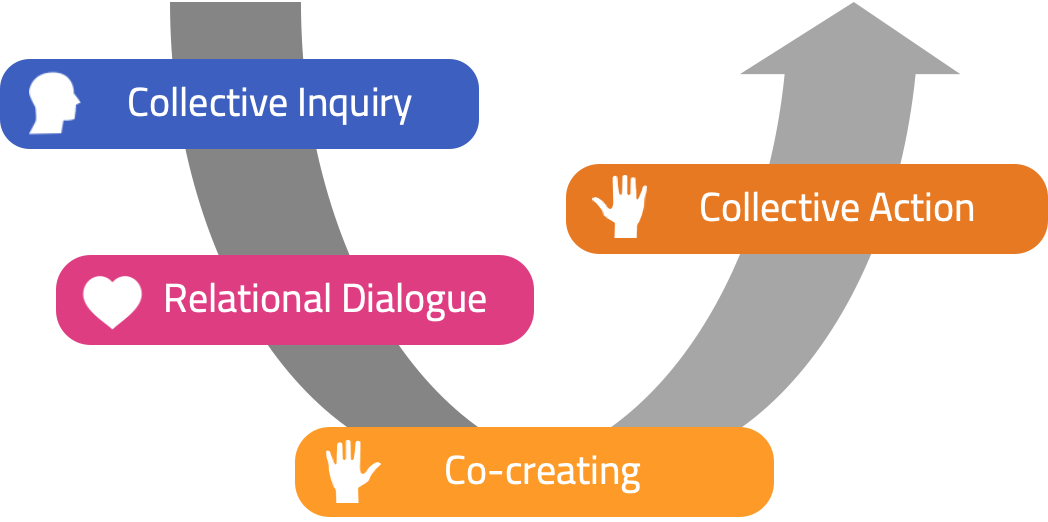
Before a group can act effectively together, it needs to move through several stages of shared inquiry:
- First, systemic inquiry — understanding the challenge from multiple perspectives, developing a shared picture of what’s actually happening.
- Next, relational dialogue — surfacing different viewpoints, naming tensions, exploring the interpretations that different parts of the organisation bring.
- Then, co-creating shared insight — developing a genuinely collective understanding of what the situation requires.
- Only then: collective action, which is now genuinely aligned.
Groups must move down into inquiry and dialogue before they can rise into action that actually sticks.
Where most offsites go wrong
Most leadership offsites skip straight to the bottom line.
Teams arrive with presentations already prepared. The conversation moves quickly toward priorities, decisions, and action plans. Stages one, two, and three are bypassed — or compressed into a brief scene-setting slot on the first morning.
But without those foundations, real alignment is impossible.
Different leaders may still hold different interpretations of the problem. Underlying tensions between functions remain unspoken. Critical assumptions never get tested. The group converges on a course of action without the perspectives ever having fully met.
The team leaves the offsite feeling aligned. Back in the business, that alignment quietly dissolves — because it was never built on shared understanding.
The stage teams are most afraid to enter
The relational stage is the one most commonly skipped — and the most important.
This is where teams surface different perspectives and work through the tensions that arise when multiple parts of the organisation view the same challenge differently. It’s uncomfortable. It can feel inefficient. It sometimes means sitting with disagreement longer than leaders find natural.
But it’s also where collective intelligence begins to emerge.
When leadership teams explore these tensions openly, they develop a richer understanding of the system they’re trying to lead. Differences that would otherwise fragment the group become resources for learning. The challenge comes into focus — together. And from that shared understanding, aligned action becomes genuinely possible rather than merely declared.
What better design looks like
If offsites are going to produce real strategic progress, the design of the conversation has to change: Creating deliberate space for exploring the business challenge together, surfacing the group dynamics that will shape execution, working through tensions constructively, and developing collective decision-making before moving to conclusions. It means slowing down — in order to go deeper.
Not just asking what will we discuss but how will we think together.
This is harder to design than a slide deck. It requires a different kind of facilitation — one focused less on presenting information and more on creating the conditions for genuine dialogue.
But the output is different too.
What becomes possible
When leadership teams follow this deeper rhythm, something shifts in the room.
Conversations become more honest. Different perspectives integrate rather than compete. Decisions reflect a richer understanding of the organisation and the challenges it faces.
The offsite stops being a moment of temporary alignment that slowly unravels.
It becomes the place where the leadership team learns how to think together.
And that capability — more than any single strategic decision made in the room — may be the most valuable thing an offsite can produce.Because in a world shaped by complexity, your ability to adapt together is your greatest competitive advantage.
Transformation starts here…
The future belongs to organisations that unlock the power of Collective Intelligence — feeling, thinking, and acting as one. Are you ready to build that capacity? Start the conversation with us.