
Leading with Head, Heart and Hand
As organisations become more complex, the limits of traditional leadership begin to show.
For much of the past century, leadership development focused heavily on one capability: thinking. Strategy, analysis, decision-making. Those who demonstrated strong intellectual ability progressed and took on greater responsibility.
These skills remain essential.
But complexity changes the nature of leadership. Challenges no longer sit neatly within a single function. Multiple perspectives interact. Tensions surface. The path forward often emerges only through conversation.
In this environment, leadership requires more than expertise.
It requires agility across three dimensions:
The ability to think clearly with others.
The ability to work through tension with people.
The ability to translate insight into coordinated action.
At Living Systems, we describe these as Head, Heart, and Hand.
Three forms of agility that allow leaders to unlock the intelligence of the system around them.
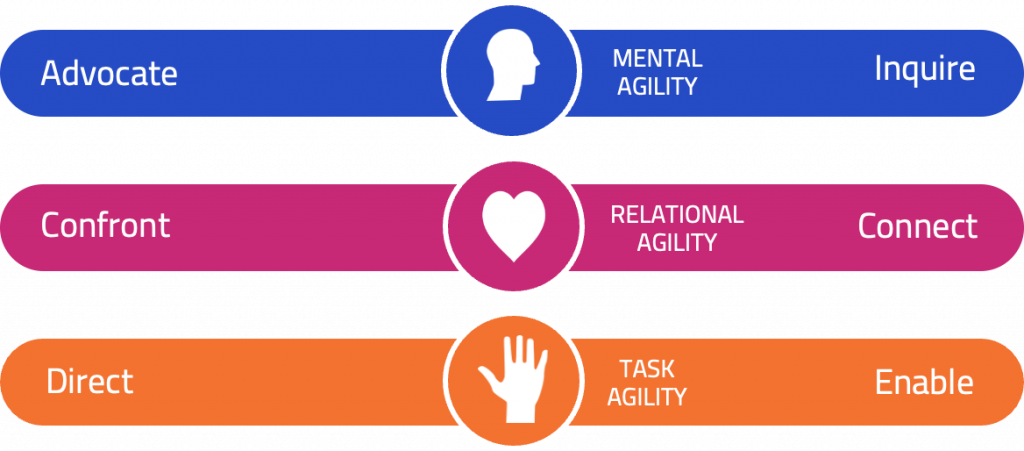
Head: thinking clearly with others
Mental agility is the capability most leaders are already familiar with — analysing situations, framing problems, interpreting data, and making decisions.
But in complex environments it requires something more subtle.
Leaders must learn to move between two poles: advocating a point of view and inquiring into the perspectives of others.
Many leaders are comfortable with one of these modes but less practiced in the other. Some naturally advocate — presenting their thinking clearly and driving decisions forward. Others lean toward inquiry — exploring possibilities and inviting different perspectives.
Mental agility lies in the ability to shift between the two.
When leaders advocate effectively, they bring clarity and direction to the conversation.
When they inquire effectively, they create space for the perspectives and information that the leader alone cannot see.
In complex challenges, neither pole is sufficient on its own. Insight emerges when leaders can hold both — contributing their thinking while remaining genuinely curious about what others may see.
Increasingly, leadership therefore means thinking clearly with others, not simply thinking for them.
Heart: working through tension with people
If mental agility shapes how leaders think, relational agility shapes how systems think together.
Complex challenges rarely affect every part of an organisation in the same way. Functions hold competing priorities. Teams see different aspects of the problem. People interpret events through different experiences and incentives.
Tension is inevitable.
Without relational agility, these tensions quickly become political. Conversations move into side discussions. Conflicts escalate upward. People protect territory rather than explore differences.
Relational agility requires leaders to work between another polarity: confronting issues honestly while maintaining connection between people.
Too much confrontation without connection creates defensiveness and conflict.
Too much connection without confrontation produces politeness but avoids the real issues.
Effective leaders learn to hold both.
They help people surface difficult truths while preserving the relationships needed for collaboration. They encourage teams to stay with disagreement long enough for deeper insight to emerge. They build a culture where feedback and challenge are normal rather than threatening.
When this happens, differences stop fragmenting the system — and begin contributing to its intelligence.
Hand: translate insight into shared action
Leadership ultimately exists to produce outcomes.
Practical agility is the ability to translate conversation and insight into meaningful action. But like the other dimensions, it also involves a polarity.
Leaders must move between directing activity and enabling others to act.
In many organisations, leaders default heavily to direction: clarifying tasks, assigning responsibilities, and driving execution. These capabilities remain important.
But complex environments also require something different.
Leaders must create the conditions where teams can take ownership of the work themselves. They must enable coordination rather than control every step.
Practical agility therefore involves working consciously with group process.
Leaders learn to step onto what we sometimes call the balcony — observing not only what the group is discussing, but how it is working together.
Sometimes the conversation needs space to explore a challenge more deeply. At other moments, the group needs structure: a reframed question, a clarified decision, or a shift toward action.
Practical agility lies in guiding the rhythm of the work — knowing when to direct and when to enable the system to move forward itself.
Why integration matters
Each of these capabilities matters on its own.
But their real power emerges when they are integrated.
Leadership in complexity requires the ability to think clearly with others about the challenge at hand, maintain cohesion when tensions emerge, and guide the group toward meaningful action.
When these three capabilities come together, something important shifts.
The leadership team stops relying solely on the intelligence of the leader.
The intelligence of the whole system becomes available.
The development challenge
Most leadership teams only discover these gaps when complexity forces them to.
When organisations face adaptive challenges — strategic pivots, rapid growth, cultural transformation — the limits of traditional leadership quickly become visible.
Teams that have spent years operating through direction and escalation suddenly find themselves needing to do something different.
They need to think through difficult problems together.
Developing Head, Heart, and Hand allows leaders to expand the intelligence available to their system. They stop being the sole source of answers and become catalysts for the collective intelligence of the organisation.
But leadership capability alone isn’t enough.
Even highly capable leaders often find that their teams still struggle to think together effectively.
Conversations remain cautious. Disagreements stay hidden. Important tensions escalate rather than being worked through.
The system has not yet developed the capacity for collective intelligence.
And that is where the real work begins.
Transformation starts here…
The future belongs to organisations that unlock the power of Collective Intelligence — feeling, thinking, and acting as one. Are you ready to build that capacity? Start the conversation with us.