
Leading in two worlds: why the org chart tells only half of the story
Many leaders have experienced the same frustration.
The organisational structure looks clear.
Roles are defined.
Strategy has been communicated.
Yet the organisation still struggles to move.
Decisions stall.
Collaboration breaks down.
Tensions between teams reappear again and again.
From the perspective of the organisational chart, everything looks correct.
But the real dynamics of the organisation are happening somewhere else.
They are happening in the network of conversations between people.
Two worlds, not one
Every organisation operates in two worlds simultaneously. These are two distinct and interconnected systems, with fundamentally different dynamics.
The first is the formal organisation — the world leaders design. Structure, roles, reporting lines, processes, governance. Visible. Intentional. Manageable.
The second is the relational organisation — the world through which work actually moves.
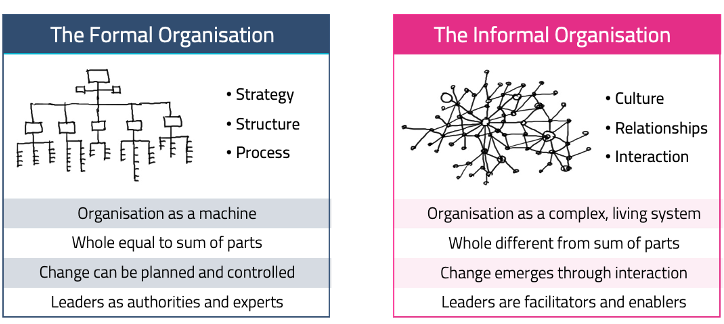
Trust shapes who speaks openly. Informal influence shapes decisions. Historical tensions shape collaboration. Information flows through conversations long before it appears in any formal report.
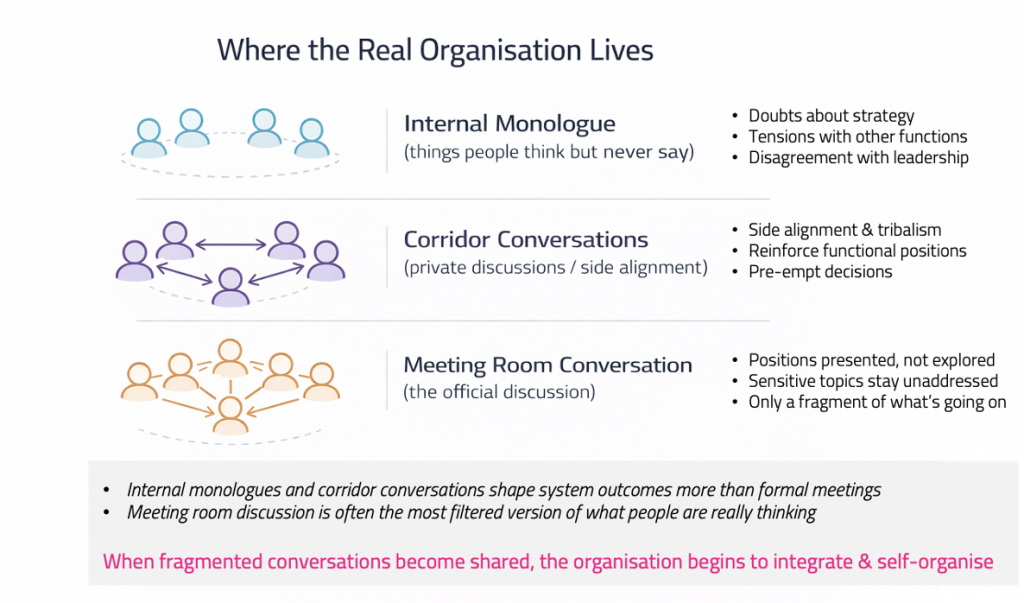
And those conversations are rarely contained within meeting rooms. They’re distributed across the organisation — some in the room, many in corridors and private exchanges, some never voiced at all. Thoughts people carry but don’t say. Frustrations that circulate privately but never surface collectively.
Taken together, these conversations form the living system of the organisation.
And most leaders are only managing half of it.
When the system can’t see itself
When these conversations remain fragmented, the organisation struggles to think clearly.
Different parts of the business hold different pieces of the picture. Finance sees one constraint. Operations sees another. Commercial teams see a different opportunity. But those perspectives rarely integrate fully. Some remain unspoken. Some surface only in private. Some appear as friction between teams that nobody quite names directly.
From the perspective of the organisational chart, the problem looks structural.
But from the perspective of the relational system, the challenge is different.
The organisation simply cannot yet see itself clearly enough to act coherently.
Why direction alone can’t solve this
In formal systems, leaders create change through direction. Set priorities. Assign responsibilities. Push decisions forward.
But relational systems don’t respond to command.
They’re shaped by connection — by trust, shared understanding, and meaning. And those qualities emerge through conversation, not instruction.
This is why some of the most persistent organisational problems resist structural solutions. The underlying dynamics are relational. Changing reporting lines does little if the conversations shaping collaboration remain unchanged. Restructuring doesn’t shift trust. New governance doesn’t resolve old tensions.
The lever is somewhere else entirely.
Why leadership must work with conversations
Once leaders begin to see the organisation as a network of conversations, the nature of leadership starts to change.
Because the real challenge is rarely a lack of intelligence inside the system.
More often, the intelligence already exists — but it is fragmented across different conversations.
One team sees part of the issue.
Another group experiences a different constraint.
Important concerns live in private discussions or internal monologue.
Until these perspectives are brought into shared dialogue, the organisation cannot fully understand the challenges it faces.
And when the system cannot see itself clearly, it struggles to act coherently.
Leadership in complex organisations therefore involves something deeper than directing work through structure.
It involves creating the conditions where fragmented conversations can become shared understanding.
Making the invisible visible
When leadership teams begin working more systemically, the first step is often the simplest — and the most overlooked.
Making the relational system visible.
One way is through relationship mapping: setting aside the org chart and mapping instead how influence, collaboration, trust, and tension actually move across the organisation. Which groups work closely together? Where are relationships weak or absent? Where do tensions repeatedly surface?
When these patterns are visualised, something shifts.
The organisation starts to appear not as a set of departments but as a network of relationships. Barriers that previously seemed mysterious begin to make sense. Dynamics that felt personal start to look systemic.
And conversations that were previously difficult to start become easier to enter.
Holding the system in inquiry
But the map itself is only the beginning.
Its value lies in the conversations it enables.
Because the map represents the system rather than any individual perspective, it gives the leadership team something to look at together — without immediately falling into positional debate. It becomes possible to ask questions that would otherwise feel too exposing.
Why do certain parts of the organisation struggle to collaborate? What assumptions are shaping these patterns? Where do tensions keep accumulating — and what are they telling us?
As these conversations unfold, something important begins to happen.
The fragments that previously lived in corridors and private discussions start moving into the room. What was implicit becomes explicit. The relational system begins to surface itself.
When systems reconnect
This stage can feel uncomfortable.
But it is also where systems begin to change.
As different parts of the organisation hear each other’s perspectives more fully, something shifts. Tensions soften. Assumptions loosen. New possibilities for collaboration appear — not because anyone mandated them, but because the understanding between people has changed.
Peter Senge has observed how quickly systems can move once people begin to see the underlying patterns shaping their behaviour. Organisations are not machines. They are living systems. When relationships reconnect and shared understanding emerges, new patterns of coordination can form naturally.
The system begins to self-organise.
Leadership in both worlds
This is where leadership in complex organisations starts to look genuinely different.
Leaders are no longer working only through structure and authority. They are working through the relational field of the organisation itself — creating spaces for systemic inquiry, helping difficult conversations surface safely, enabling different parts of the system to understand each other more clearly.
Operating in both worlds at once.
The formal organisation provides direction. The relational system provides intelligence. When those two worlds begin to work together, the organisation becomes capable of something far more powerful than coordination.
It becomes capable of seeing — and acting — as a whole.
Transformation starts here…
The future belongs to organisations that unlock the power of Collective Intelligence — feeling, thinking, and acting as one. Are you ready to build that capacity? Start the conversation with us.