
Organisational Change: Why Different Challenges Need Different Leadership
Leaders today describe their environment as complex.
Markets shift quickly. Technology evolves rapidly. Organisations face competing pressures from customers, regulators, and internal stakeholders simultaneously.
But complexity is a word that covers very different kinds of challenges. And that distinction matters — because applying the wrong kind of intelligence to the wrong kind of complexity is one of the most common and costly mistakes leadership teams make.
Not all complexity is the same
Some problems are difficult but ultimately solvable through expertise and analysis. Others involve multiple perspectives, competing interests, and shifting conditions that resist clean solutions. And some challenges go further still — requiring organisations to rethink their assumptions about the future itself.
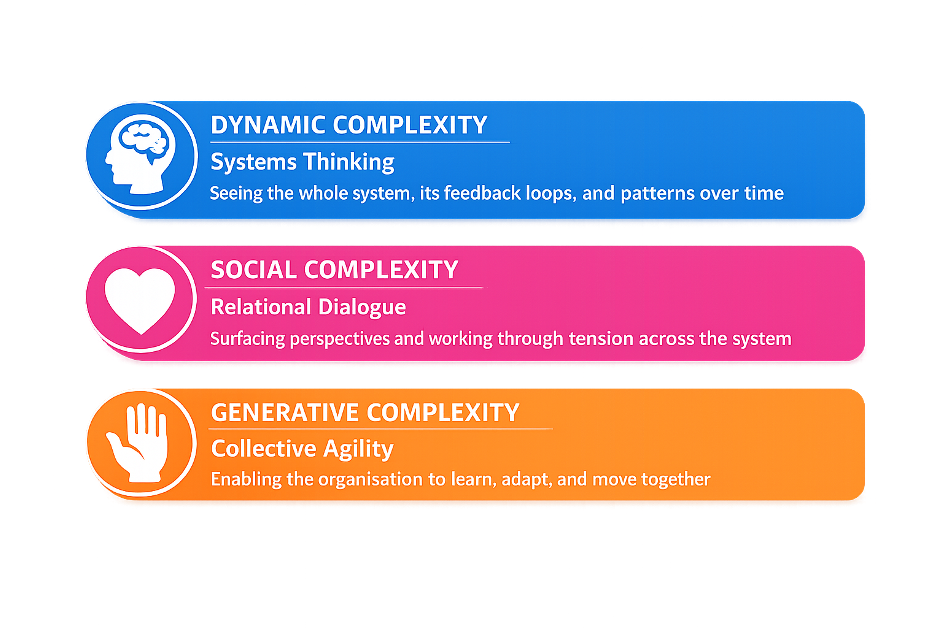
DIfferent forms of complexity require different kinds of intelligence. Three distinct forms. Three different leadership responses.
Dynamic complexity: too many moving parts
The first form is dynamic complexity.
This arises when systems contain many interacting variables that unfold across time. Cause and effect still exist — but the relationships between actions and outcomes are difficult to trace because they move through multiple feedback loops.
Supply chains, financial systems, and large operational networks often display this form of complexity. When leaders intervene in one part of the system, consequences appear somewhere else — later, and often in ways that were not anticipated. A pricing decision ripples into procurement. A cost reduction in one quarter creates a capacity problem in the next.
The instinct in these situations is usually to analyse harder: to build better models, tighten the plan, and increase oversight.
But dynamic complexity reveals the limits of that approach. The reason consequences appear unexpectedly is not simply a failure of analysis — it is often a failure of seeing. Leaders are looking at parts of the system rather than the whole.
The feedback loops are not just technical inconveniences. They are the system communicating — signalling that actions in one place are connected to outcomes in another in ways the organisational chart does not reveal.
Responding to dynamic complexity therefore requires more than improved management tools. It requires systems thinking — the ability to see the organisation as a whole, trace the connections between its parts, and understand how patterns of behaviour emerge and reinforce themselves over time.
When leaders develop this capacity, they stop being surprised by the system.
They begin to read it.
Planning, analysis, and disciplined execution remain essential. But they become far more powerful when grounded in a genuine understanding of how the whole system works.
Social complexity: different people see the system differently
The second form is social complexity.
Here the challenge isn’t only the system itself — it’s the fact that different people experience that system in fundamentally different ways.
Finance views a strategic issue through the lens of risk and cost. Commercial teams focus on market opportunity. Operations prioritises reliability and efficiency. Each perspective contains part of the truth. None contains all of it.
In stable conditions this is manageable. But in volatile environments something else begins to happen. The very mechanisms designed to help organisations operate efficiently — structure, process, functional accountability — start working against adaptation. Departments optimise their own priorities. Targets reinforce local objectives. Processes built for predictability become resistant to change.
Finance pushes for cost discipline. Commercial teams push for growth. Operations pushes for stability. Each position is rational from within the function. At the level of the whole organisation, the system struggles to move.
The challenge is no longer technical. It has become relational.
Addressing social complexity requires a different kind of intelligence. Leaders must create the conditions in which different perspectives can be surfaced, explored, and integrated. Dialogue becomes essential. When leadership teams help the system explore its tensions openly, the organisation can move beyond functional positions and develop a shared understanding of what it actually faces.
This is where collective intelligence begins to unlock.
Generative complexity: the path forward must be discovered together
The third form goes deeper still.
The third form of complexity goes deeper still.
In generative complexity, the future itself is uncertain. Leaders are no longer choosing between known options or reconciling existing perspectives. They are navigating situations where the path forward does not yet fully exist.
Emerging technologies, new business models, and large societal shifts often create this kind of complexity. In these environments the past becomes a less reliable guide to the future. Analysis alone cannot provide the answer — because the question itself keeps changing.
No single leader, and no single function, can see enough of the emerging picture to act on it alone. The signals are distributed across the system — in what different teams are noticing, experiencing, and sensing at the edges of the organisation. Some see early shifts in customer behaviour. Others feel the strain of processes that no longer quite fit. Others are experimenting with approaches that haven’t yet been named. Leadership requires creating the conditions for those signals to surface, connect, and be taken seriously.
Through that process, new possibilities begin to emerge — not from any individual perspective, but from the interaction of many.
Rather than reacting to change after it arrives, the organisation begins to participate in shaping what comes next.
This is where leadership shifts from problem-solving to co-creation.
Why the distinction matters
Many leadership teams struggle with complexity not because they lack intelligence, but because they apply the wrong approach to the wrong type of challenge.
Dynamic, social, and generative complexity often appear together inside organisations. But each requires a different kind of response.
When leaders encounter dynamic complexity, the instinct is usually correct: analyse the system, understand the feedback loops, and coordinate action across its parts.
But when the challenge is social, analysis alone cannot resolve it. Different parts of the organisation see the situation differently, and those perspectives must be surfaced and worked through.
And when the challenge becomes generative — when the future itself is uncertain — the organisation must go further still. It must learn how to adapt collectively as new information emerges.
Yet many organisations continue to rely on the same tools regardless of the type of challenge they face.
More analysis is commissioned.
More plans are produced.
More governance processes are introduced.
These tools remain valuable — but they are designed primarily for dynamic complexity.
When the challenge is social or generative, progress depends less on analysis and more on how the system thinks and works together.
The intelligence of the system
In complex environments, no individual leader can hold enough perspective to fully understand the challenges facing the organisation.
Each part of the system sees something different.
Finance sees financial risk.
Operations sees operational constraints.
Commercial teams see market opportunities.
None of these perspectives are wrong.
But none of them are sufficient on their own.
Insight begins to emerge when these perspectives interact — when assumptions are surfaced, tensions are explored, and different experiences of the system are brought into dialogue.
In this sense, the intelligence required to navigate complexity rarely sits inside a single role or function.
It exists within the system itself.
The task of leadership therefore shifts.
Leaders are not simply responsible for providing answers. They are responsible for creating the conditions in which the organisation can see more clearly and think more deeply together.
Leading in complexity
Recognising these three forms of complexity changes how leadership operates.
Dynamic complexity requires systems thinking — the ability to understand how actions ripple through the organisation over time.
Social complexity requires relational intelligence — the ability to surface different perspectives and work through the tensions that naturally arise between them.
Generative complexity requires collective agility — the capacity of leadership teams and organisations to learn, adapt, and act together as circumstances evolve.
Leadership in complex environments therefore becomes less about controlling the organisation and more about enabling the intelligence of the system itself.
When leaders can see the system clearly, work with its relational dynamics, and create the conditions for collective adaptation, complexity stops being simply a source of difficulty.
It becomes a source of learning, resilience, and possibility.
But there’s one more challenge.
Even when organisations develop the capability to navigate complexity, something else can quietly emerge.
As systems grow larger and more interconnected, they can lose the ability to see themselves clearly. Different parts of the organisation begin operating in separate realities. Shared understanding fragments. Dialogue breaks down.
And when that happens, complexity can turn into something far more dangerous.
Polarisation.
Which is where the final article in this series begins.
Ready so start the transformation? Start the conversation with us.